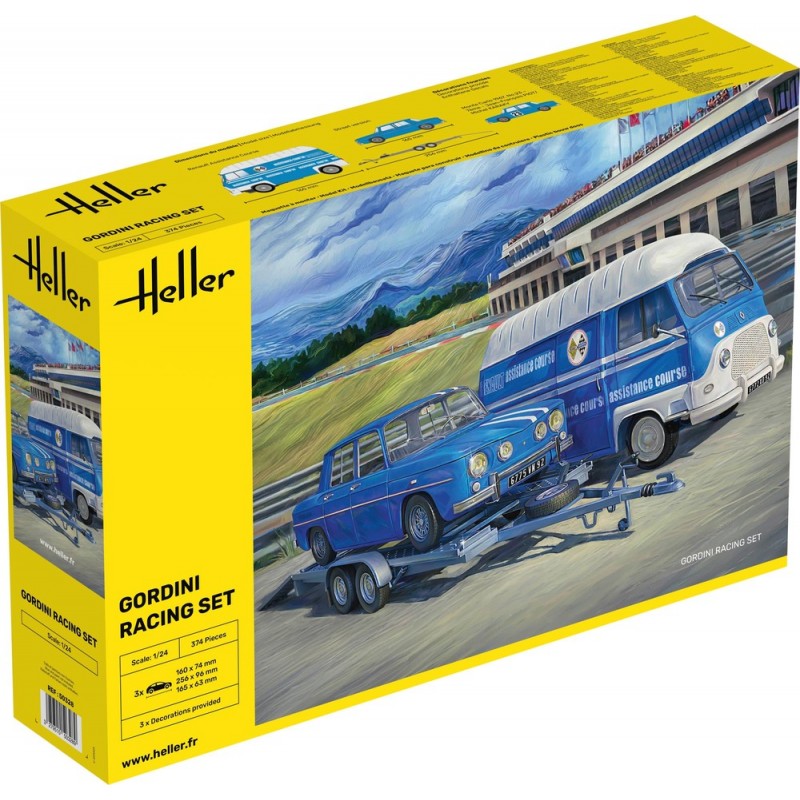
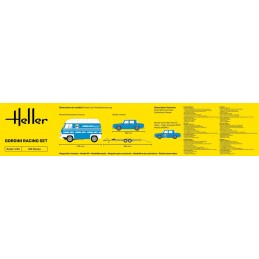
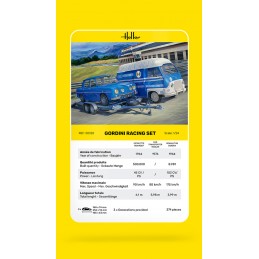
In the early 1980s, Renault Assistance Course was the "mobile workshop service" for racing and rally teams. The vans were used to transport the vehicles, placed on trailers, to the race sites. Once there, a small car camp was set up and the final touches were carried out on the racing cars. Since the vans were well stocked with spare parts, accessories, tools, and other items, any damage incurred during racing or rallying engagements could be quickly repaired by the mechanics on the circuit. The race service team took care of getting the vehicle back to roadworthy condition as quickly as possible. Not only were the challenges of daily work on and off the circuit met with efficiency, but these mobile assistance stations sometimes served as temporary accommodation for team members. One such van was the Renault Estafette, based on the Citroën's front-wheel drive system, which therefore offered a large, flat loading area, four-wheel independent suspension, a sliding side door, and a three-leaf rear door. This was initially produced as a van with a payload of 800 kg, then 1000 kg from 1965, with a flat or high roof and a short or long wheelbase. The first models used the 845 cm³ engine from the Dauphine with 32 hp, which was replaced in 1962 by the "Sierra Cléon fonte" engine from the Renault 8 with 1108 cm³ and 45 hp and in 1968 by the 1289 cm³ engine from the Renault 12. Produced in more than 500,000 units until 1980, the Estafette became a symbol of its time.
Plastic model to build and paint.
Glue and paint brushes not included.
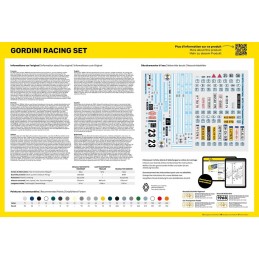
Model dimensions: 160x74 mm / 256x76 mm and 165x63 mm 374 pieces